VIT^L: A new framework for verifiable, reusable research
Kristen Ratan, Contributors to the NASEM Roundtable Action Collaboratives
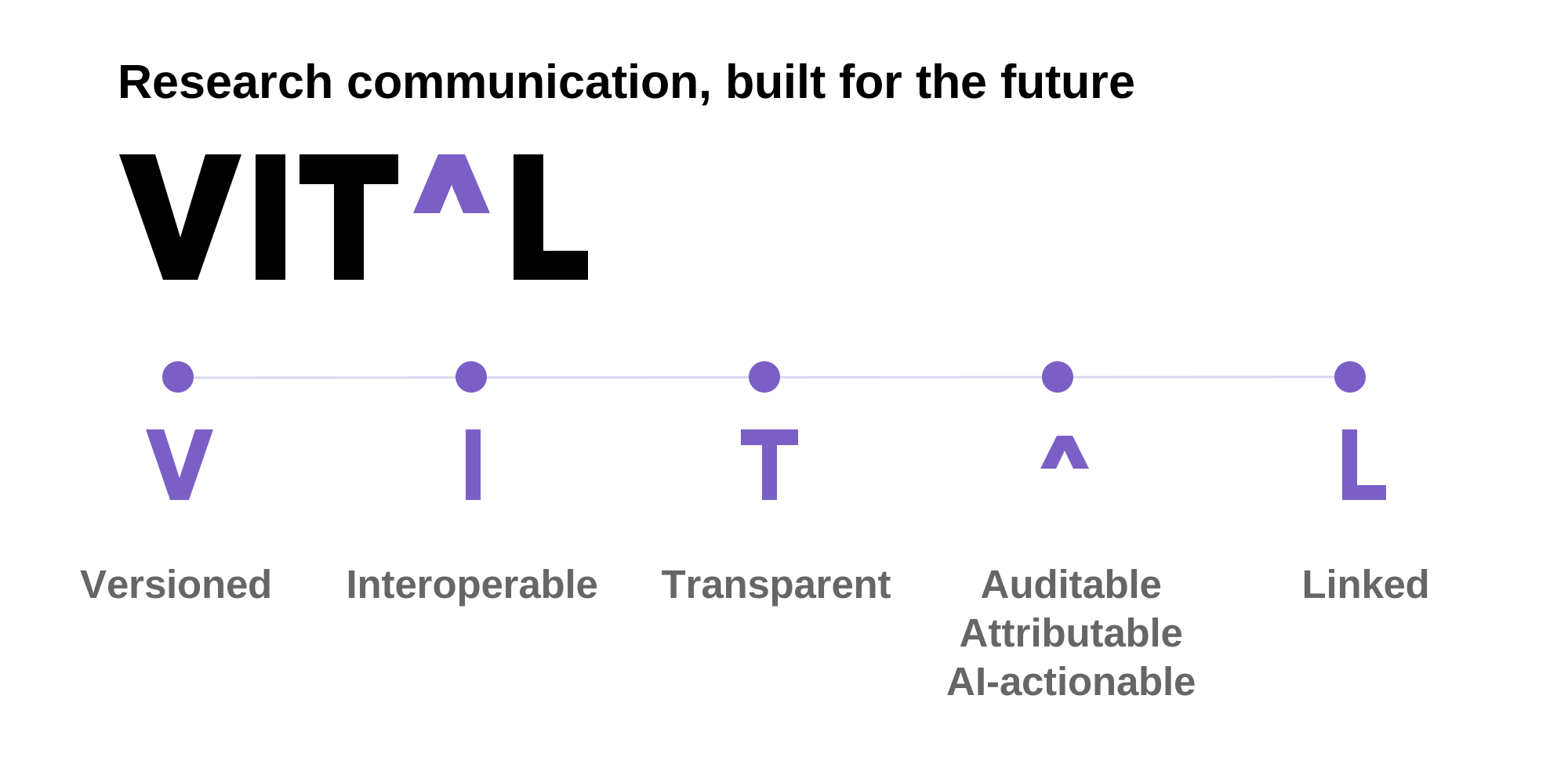
Emerging from the US National Academies Roundtable on Aligning Incentives for Open Science, a focused Action Collaborative of experts proposes VIT^L, a framework for sharing research modularly, with all outputs versioned and networked, as early as possible in ways that are checkable.
The data is clean and analyzed. The code runs. The results hold up. And then, for a lot of researchers, the work sits for months while someone writes the paper. The article often doesn’t include the data and code, and by the time it goes through the publication process, the team has moved on and opportunities to engage with the work early, iterate, and build upon it are delayed and sometimes lost.
That gap is where a new framework from an action collaborative of the US National Academies’ Roundtable on Aligning Incentives for Open Science starts. The Action Collaborative calls its proposal VIT^L, Versioned, Interoperable, Transparent, Auditable, Attributable, and AI-Actionable, and Linked. It sets out how research communication, done well and alongside the research rather than after it, can make the work actionable by humans and machines alike, helping to accelerate research outcomes and their benefits to society.
From these efforts, we have launched a new conference for the broader open science, open source, research reform, research impact, and research integrity community to come together and shape the VIT^L framework and its associated initiatives. The conference is Convergence scheduled for June 16-18, 2027 in Montreal, directly following the Metascience 2027 conference.
The article was built for print
Modern research happens mostly in the digital space yet is still communicated through a static narrative, which is a relic of the predigital era and is often lacking any links to the underlying data, code, and methods Researchers often write the narrative last, so the material that would let someone verify or reuse the work ends up in supplementary files, or nowhere. Researchers know that the system rewards the finished article and sharing work more comprehensively isn’t rewarded or made easy. But the stakes have changed. AI is speeding up the production of new results by carrying out parts of the research process, from generating hypotheses and running experiments to analysing data and writing up findings. But producing results isn’t the same as verifying them and integrating them into the collective understanding that drives breakthroughs.
Seven properties, one framework
Our answer is a set of properties research communication should have:
Versioned. Work is released as labeled, identifiable versions, so its development and corrections are visible.
Interoperable. Outputs and their metadata follow open standards and move between platforms without losing context.
Transparent. Data, code, protocols, and checks are identifiable, available, and understandable.
Auditable. Every check is on the record, and every claim links to its evidence.
Attributable. Credit goes to whoever made each piece, from a dataset to a figure, and follows it wherever it’s reused.
AI-actionable. People and machines can rerun analyses, reuse data, or test results directly, without rebuilding them from a narrative.
Linked. Outputs connect to the work they build on and the work that builds on them.
The framework adds technical detail to earlier open science principles. It also proposes moving sharing much earlier in a researcher’s workflow, well before a manuscript exists, to ensure the most comprehensive and reusable reporting possible.

Save the date
A convergence of science.
Join us June 16–18, 2027 in Montreal for a three-day conference to transform how we share, fund, publish, measure, and reuse research. Let’s push science further—together.
What VIT^L is not
VIT^L properties don’t guarantee good research. The framework doesn’t promise rigor or integrity; it describes the conditions under which those qualities can be seen, verified, and rewarded. It also isn’t a rebrand of open science, which represents a much broader umbrella. VIT^L describes what open research needs to look like to be useful now that AI is part of how research gets read and built on.
Share earlier, in logical chunks, with versions
The first building block is an environment where researchers can share their work iteratively, at the level of individual figures and datasets rather than whole papers. Each unit can be reused, commented on and updated, with every version recorded so others can see how it changed and why. An open standard such as the Open Exchange Architecture (OXA) can then package data, code, protocols and narrative into modular units that many tools can read. For example, openRxiv and Curvenote have converted the full bioRxiv and medRxiv preprint corpus into structured, OXA-style documents.
Signals, not proxies
Today, readers judge research mostly by proxies like a journal’s name. VIT^L proposes signals instead: machine-readable, verifiable statements about a specific output, such as “the data is deposited” or “the code ran,” along with who or what made the check. Automated checks would run when work is shared, and slower evaluation, including peer review, would build up over time. Because each signal is tied to a specific output and its contributors, credit can follow the actual contribution and collaboration behind the work, rather than authorship of a single paper.
Connecting the dots
Review platforms publish citable reviews, and funders are changing what they ask for. But most efforts run on their own, without shared standards or coordinated funding. We advocate for a set of principles that many organizations can implement, and no single one owns. It’s frank about the risks: signals can be gamed, infrastructure can be captured, extra work could land on researchers, and adoption will be uneven across fields. Its own focus so far has been mostly on STEM.
The group is frank about the pitfalls: bad actors might game signals, platform infrastructure risks capture, additional burdens could land on scholars, and uptake will likely be uneven across disciplines - particularly given the initial emphasis on STEM fields. Additional challenges will undoubtedly surface. Addressing these obstacles head-on will be a core task at Convergence, where the broader community can collective troubleshoot solutions.
Come build it in Montreal
The VIT^L Framework will be published later in 2026, and we will invite comments and discussion. Save the date for an ICOR webinar (happening December 8th: 8am PDT, 11am EDT, 4pm GMT, 5PM CT) to discuss the framework and its connection to the Convergence Conference. We are inviting the community to read the Framework, comment on it, and contribute to add and fill gaps.
Then bring your ideas to Convergence, June 16-18, 2027, in Montreal, just after Metascience 2027. It’s where the people building these pieces get in one room and start connecting them.
Many themes are emerging to guide discussions at Convergence including how research is assembled in a modern workflow, the record of versions, moving towards a more modular, versioned, and machine-ready system, signals of openness, provenance and trust, curation, synthesis and reuse, and governance and sustainable funding for an open research commons.
Sign up for updates at convergescience.org.